
Alex Hormozi: "My business has stopped growing..what should I do?"
Last updated: Jun 15, 2023
The video is about a framework that Alex Hormozi uses to analyze businesses and how to use it to instantly 2-3 exit your own business.
This video by Alex Hormozi was published on Oct 1, 2021.
Video length: 09:25.
In this video, Alex Hormozi shares a framework for analyzing a business that can help entrepreneurs instantly 2-3x their business.
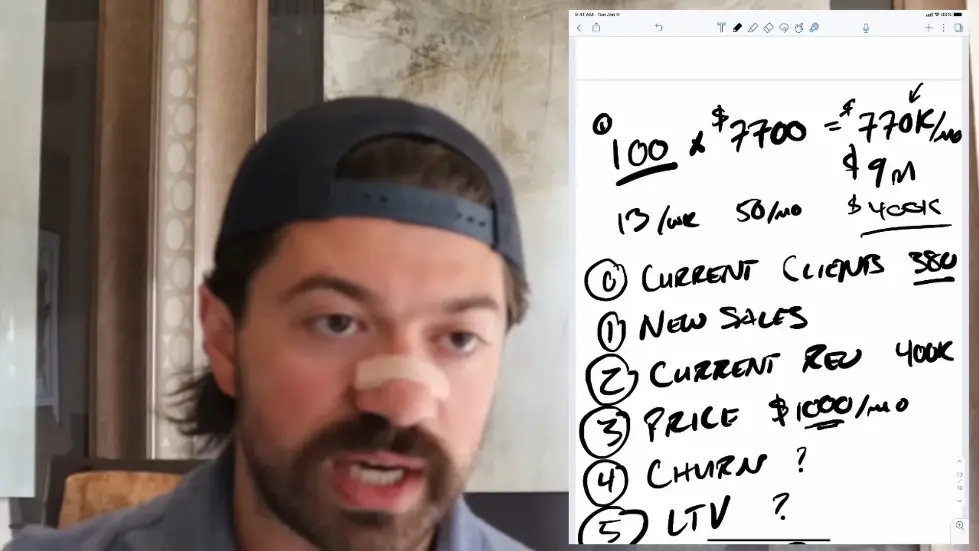
He explains the five variables needed for the framework: number of new sales per month, current revenue, price, churn, and lifetime value. He then walks through a hypothetical example of a business with 100 new sales per month, 380 active clients, a $1,000/month price, and a 13% churn rate.
Using this information, he calculates the business's hypothetical max and lifetime gross profit per customer, which can help entrepreneurs analyze the potential opportunity of their business.
- Alex Hormozi shares a framework to analyze businesses and how to use it to instantly 2-3 exit your own business.
- The framework requires five variables: new sales per month, current revenue, price, churn, lifetime value, and gross profit.
- A hypothetical example is used to demonstrate how to calculate churn and lifetime value to determine the hypothetical max revenue of a business.
- Business owners can use this framework to calculate their own churn and lifetime value, determine their hypothetical max revenue, and make informed decisions about growth opportunities.
- It is important to ensure that customer acquisition cost is less than lifetime gross profit per customer.
"My business has stopped growing..what should I do?" - YouTube

Introduction
- Alex Hormozi is an entrepreneur, investor, and CEO of Acquisition.com.
- He shares a framework that he uses to analyze businesses and how to use it to instantly 2-3 exit your own business.
- The framework requires five variables, and he will show how to get the two hardest numbers that most people don't know how to get within their business.

The Five Variables
- The number of new sales per month.
- Current revenue.
- Price.
- Churn.
- Lifetime value.
- Gross profit.
Analyzing a Hypothetical Example
- A business was doing 100 new sales per month and $400k in revenue.
- They had 380 clients paying $1,000 per month, but they didn't know their churn or lifetime value.
- Alex helped them calculate their churn, which was 13%.
- He then calculated their lifetime value per customer, which was $7,700.
- Using these numbers, he determined that the business would cap out at $770k per month or about $9 million per year.
- The business had over 90% gross margins, which meant their lifetime gross profit per customer was $7,000.

"My business has stopped growing..what should I do?" - YouTube
Using the Framework to Analyze Your Own Business
- Calculate your churn and lifetime value.
- Use these numbers to determine your hypothetical max revenue.
- Calculate your gross profit per customer.
- Ensure that your customer acquisition cost is less than your lifetime gross profit per customer.
- Use this information to make informed decisions about your business and potential growth opportunities.

Framework for Analyzing Businesses
- A business can only grow by getting more customers or making them worth more.
- Increasing customer acquisition or increasing customer value are the only ways to grow a business.
- Reducing churn can significantly increase customer value and overall revenue.
- Private equity firms look for businesses with high growth, stickiness, and profitability.
- Removing the biggest constraint in a business can allow it to grow.

Calculating Hypothetical Max and Weak Points
- Calculating hypothetical max with current numbers can reveal weak points in a business model.
- Knowing how many new customers, current clients, and revenue a business has can help calculate hypothetical max.
- Calculating churn can help identify areas for improvement in a business model.
- The theory of constraints suggests that businesses will grow up to their nearest constraint, so removing constraints can allow for growth.
- Smart business owners focus on doing the fewest things that get them the most returns.
Watch the video on YouTube:
"My business has stopped growing..what should I do?" - YouTube
Related summaries of videos:
- Alex Hormozi: NEVER lower your prices...
- Alex Hormozi: 5 UNTAPPED Industries that could make you a BILLIONAIRE
- Alex Hormozi: I cracked Starbucks RECURRING SALES model and built a FORTUNE...
- Alex Hormozi: How to get unlimited funding to build your business in 30 days...
- Alex Hormozi: Why PRETENDING to be RICH will make you POOR..
- Alex Hormozi: 5 Things that BILLIONAIRES think about that MILLIONAIRES don't...
- Alex Hormozi: The ONLY 4 ways to MAKE BILLIONS as a service based business..
- Alex Hormozi: The SIMPLE FORMULA that has DESTROYED BILLION DOLLAR BUSINESSES
- Alex Hormozi: This QUICK FIX will make us an EXTRA $10,000,000 next year..
- Alex Hormozi: How to build a $100,000,000 business...the sh@$ nobody will tell you..
- Home
- About us
- Contact
- Book Summaries 0-9
- Book Summaries A
- Book Summaries B
- Book Summaries C
- Book Summaries D
- Book Summaries E
- Book Summaries F
- Book Summaries G
- Book Summaries H
- Book Summaries I
- Book Summaries J
- Book Summaries K
- Book Summaries L
- Book Summaries M
- Book Summaries N
- Book Summaries O
- Book Summaries P
- Book Summaries Q
- Book Summaries R
- Book Summaries S
- Book Summaries T
- Book Summaries U
- Book Summaries V
- Book Summaries W
- Book Summaries X
- Book Summaries Y
- Book Summaries Z
- Jay Shetty Podcast - Summaries
- Tom Bilyeu Impact Theory - Summaries
- Lex Fridman - Summaries
- Diary of a CEO - Summaries
- Alex Hormozi - Summaries
