
Lee Cronin: Controversial Nature Paper on Evolution of Life and Universe | Lex Fridman Podcast #404
Last updated: Dec 10, 2023
The video is about a controversial paper published in Nature by chemist Lee Cronin, which proposes a new theory about the evolution of life and the universe. The paper suggests that the complexity of objects in the universe can be quantified by trying to find the number of steps it took to create them, and that this can help determine if they were built by a process similar to evolution. The theory also suggests that the set of constraints to construct an object from its elementary building blocks is quantifiable, and that the history of an object is part of what is used to describe its complexity. The video discusses the assembly theory in more detail, including the assembly index, which is the minimum number of steps required to add the parts of an object together to reproduce it. The video also touches on the controversy surrounding the paper and the interesting discussions it has generated.
This video by Lex Fridman was published on Dec 9, 2023.
Video length: 03:19:22.
The video is about a controversial paper published by Lee Cronin in Nature that proposes a new theory of the evolution of life and the universe.
The paper suggests that the complexity of objects in the universe can be quantified by determining the number of steps it took to create them and looking at how many copies of the object exist. Cronin argues that this theory can help us understand the relationship between objects and their evolution, and the possibility of finding alien life in the universe.
The video features a conversation between Cronin and Alex Fridman, where they discuss the implications of the paper and the importance of understanding the evolution of life and the universe.
* The video is about a controversial paper published in Nature by chemist Lee Cronin, which proposes a new theory about the evolution of life and the universe. * The paper suggests that the complexity of objects in the universe can be quantified by trying to find the number of steps it took to create them, and that this can help determine if they were built by a process similar to evolution. * The set of constraints to construct an object from its elementary building blocks is quantifiable, and the history of an object is part of what is used to describe its complexity. * The Assembly Theory is a new theory about the evolution of life and the universe, which suggests that the complexity of objects in the universe can be quantified by trying to find the number of steps it took to create them. * The Assembly Theory also suggests that the set of constraints to construct an object from its elementary building blocks is quantifiable, and that the history of an object is part of what is used to describe its complexity. * The video discusses the Assembly Theory in more detail, including the assembly index, which is the minimum number of steps required to add the parts of an object together to reproduce it. * Molecules can be used as an example to illustrate the Assembly Theory. * Breaking a molecule apart and forming bonds again is a process that can be used to create a new molecule. * The Assembly Theory can be applied to molecules to determine the minimum number of steps required to create them. * The computational complexity of figuring out the shortest path to create a molecule is discussed. * There are shortcuts to determine the complexity of an object. * One way to measure the complexity of a molecule is to shine light on it and look at the absorbances in the infrared region. * Another way to measure the complexity of a molecule is to use nuclear magnetic resonance (NMR) to determine the number of different genetic environments in a molecule. * The Assembly Theory is a generalizable method for determining the complexity of objects. * The Assembly Theory is controversial because it reaches for a bigger, more general theory of objects in the universe. * The Assembly Theory is still in its early stages, and researchers are just learning how to compute the assembly index of a graphical object. * The assembly index is determined by first determining the resolution of the object, looking at the surface area, and then adding the pixels together to make the overall emoji. * Assembly theory is not just about compression, but it also tells you about how much information is required on a chain of events. * The assembly universe is like anything goes, just this just comment toal kind of explosion in everything so that's the biggest one that's the biggest one it's massive assembly Universe assembly possible assembly contingent assembly observed and uh on the y axis is assembly steps and time yeah and you know in the x-axis as as the thing expands Through Time more and more unique objects appear. * In the assembly possible laws of physics come in in this case in chemistry Bonds in assembly so that means those are actually constraints I guess yes and they're the only constraints they're the constraints at the base the way to look at is you got all your atoms they're quanti you can just bung them together so then you can become a kind of so in the way in computer science speak I suppose the assembly universe is just like no laws of physics things can fly through mountains beyond the speed of light in the assembly possible you have to apply the laws of physics but you can get access to all the motifs instantaneously with no effort that means you could make anything then the assembly contingent says no you can't have access to the highly assembled object in the future until you've done the work in the past on the causal chain and that's really the really interesting shift where you go from assembly um possible to assembly contingent that is really the key thing in assembly theory that says you cannot just have instantaneous access to all those memories you have to have done the work somehow the universe has to have somehow built a um a system that allows you to select that path um rather than other paths and then the final thing the assembly observed is basically saying oh the these are the things we actually see we can go backwards now and understand that they have been created by this this causal process says wait a minute so.
Summary of the Text
- The video is about a controversial paper published in Nature by chemist Lee Cronin, which proposes a new theory about the evolution of life and the universe.
- The paper suggests that the complexity of objects in the universe can be quantified by trying to find the number of steps it took to create them, and that this can help determine if they were built by a process similar to evolution.
- The theory also suggests that the set of constraints to construct an object from its elementary building blocks is quantifiable, and that the history of an object is part of what is used to describe its complexity.
- The video discusses the assembly theory in more detail, including the assembly index, which is the minimum number of steps required to add the parts of an object together to reproduce it.
- The video touches on the controversy surrounding the paper and the interesting discussions it has generated.

The Assembly Theory
- The video discusses the Assembly Theory, a new theory about the evolution of life and the universe.
- The theory suggests that the complexity of objects in the universe can be quantified by trying to find the number of steps it took to create them.
- This can help determine if they were built by a process similar to evolution.
- The set of constraints to construct an object from its elementary building blocks is quantifiable, and the history of an object is part of what is used to describe its complexity.
- The video discusses the assembly theory in more detail, including the assembly index, which is the minimum number of steps required to add the parts of an object together to reproduce it.

Molecules and Assembly Theory
- The video explains that molecules can be used as an example to illustrate the Assembly Theory.
- Breaking a molecule apart and forming bonds again is a process that can be used to create a new molecule.
- The video shows how a Lego object can be broken down into smaller blocks and then assembled back together in a different way to create a new object.
- The Assembly Theory can be applied to molecules to determine the minimum number of steps required to create them.

Computational Complexity
- The video discusses the computational complexity of figuring out the shortest path to create a molecule.
- The best way to look at it is to take the fully constructed Lego Castle or whatever your favorite Lego world is and figuring out how to get there from the building basic building blocks.
- The video explains that the best way to look at it is to take 13 copies of the molecule and just cut all the bonds so that the molecule is broken down into its basic building blocks.
- The video notes that as the object gets bigger, it becomes increasingly difficult to determine the shortest path to create it.

Shortcuts and Complexity Measurement
- The video explains that there are shortcuts to determine the complexity of an object.
- One way to measure the complexity of a molecule is to shine light on it and look at the absorbances in the infrared region.
- The video notes that this method gives a good correlation with the assembly index.
- Another way to measure the complexity of a molecule is to use nuclear magnetic resonance (NMR) to determine the number of different genetic environments in a molecule.

Generalizability and Controversy
- The video explains that the Assembly Theory is a generalizable method for determining the complexity of objects.
- The video notes that the Assembly Theory is controversial because it reaches for a bigger, more general theory of objects in the universe.
- The video suggests that the Assembly Theory is a nice hack, but it is not yet clear how well it will generalize beyond chemistry.
- The video notes that the Assembly Theory is a controversial topic, and there are different opinions about its validity and usefulness.

Assembly Theory of Emoticons
- The video discusses the assembly theory of emoticons, which involves taking emojis, pixelating them, and working out the assembly index for emoji.
- The assembly index is the minimum number of steps required to add the parts of an object together to reproduce it.
- The video also touches on the controversy surrounding the paper and the interesting discussions it has generated.
- The assembly theory is still in its early stages, and researchers are just learning how to compute the assembly index of a graphical object.
- The assembly index is determined by first determining the resolution of the object, looking at the surface area, and then adding the pixels together to make the overall emoji.
Assembly Theory and Compression
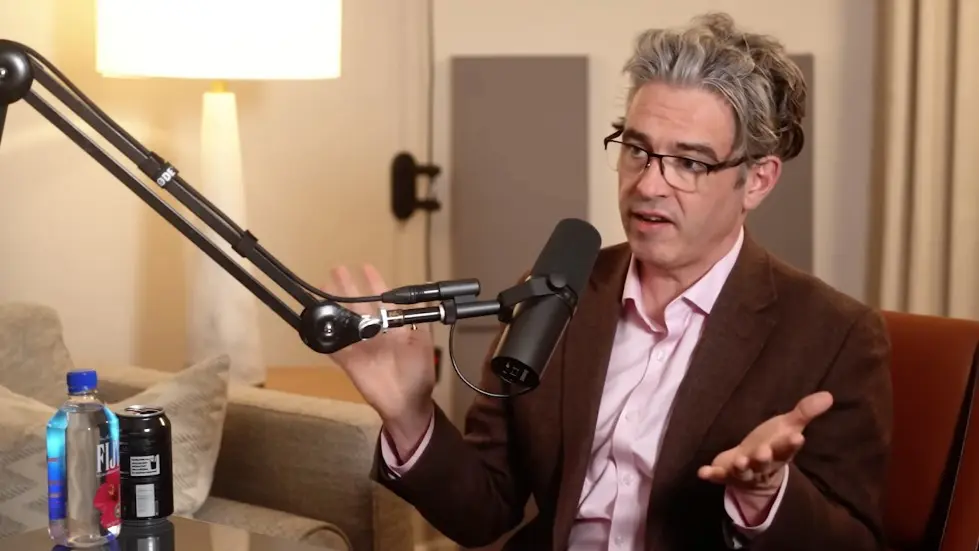
- Assembly theory is not just about compression, but it also tells you about how much information is required on a chain of events because the nice thing is if you when you do compression in computers science we're wandering a bit here but it's kind of worth wandering I think in you you um assume you have instantaneous access to all the information in the memory yeah assembly Theory you say no you don't get access to that memory until you've done the work and then you've done access to that memory you can have access but not to the next one and this is how in assembly Theory we talk about the four universes the assembly Universe the assembly possible and the assembly contingent and then the assembly observed and they're all all scales in this combinatorial universe yeah can you explain each one of them
- The assembly universe is like anything goes, just this just comment toal kind of explosion in everything so that's the biggest one that's the biggest one it's massive assembly Universe assembly possible assembly contingent assembly observed and uh on the y axis is assembly steps and time yeah and you know in the x-axis as as the thing expands Through Time more and more unique objects appear
- In the assembly possible laws of physics come in in this case in chemistry Bonds in assembly so that means those are actually constraints I guess yes and they're the only constraints they're the constraints at the base the way to look at is you got all your atoms they're quanti you can just bung them together so then you can become a kind of so in the way in computer science speak I suppose the assembly universe is just like no laws of physics things can fly through mountains beyond the speed of light in the assembly possible you have to apply the laws of physics but you can get access to all the motifs instantaneously with no effort that means you could make anything then the assembly contingent says no you can't have access to the highly assembled object in the future until you've done the work in the past on the causal chain and that's really the really interesting shift where you go from assembly um possible to assembly contingent that is really the key thing in assembly theory that says you cannot just have instantaneous access to all those memories you have to have done the work somehow the universe has to have somehow built a um a system that allows you to select that path um rather than other paths and then the final thing the assembly observed is basically saying oh the these are the things we actually see we can go backwards now and understand that they have been created by this this causal process says wait a minute so

Assembly Theory and Controversy
- The paper published in Nature by chemist Lee Cronin proposes a new theory about the evolution of life and the universe.
- The theory suggests that the complexity of objects in the universe can be quantified by trying to find the number of steps it took to create them, and that this can help determine if they were built by a process similar to evolution.
- The set of constraints to construct an object from its elementary building blocks is quantifiable, and that the history of an object is part of what is used to describe its complexity.
- The video discusses the assembly theory in more detail, including the assembly index, which is the minimum number of steps required to add the parts of an object together to reproduce it.
- The video also touches on the controversy surrounding the paper and the interesting discussions it has generated.

The Evolution of Life and the Universe
- The complexity of objects in the universe can be quantified by trying to find the number of steps it took to create them.
- This can help determine if they were built by a process similar to evolution.
- The set of constraints to construct an object from its elementary building blocks is quantifiable.
- The history of an object is part of what is used to describe its complexity.

Assembly Theory
- The assembly theory suggests that the complexity of objects in the universe can be quantified by trying to find the number of steps it took to create them.
- This can help determine if they were built by a process similar to evolution.
- The assembly index is the minimum number of steps required to add the parts of an object together to reproduce it.
- The difference between the assembly universe in Tesla land and the Tesla Factory is that everyone says no Teslas are just easy, they just spring out, you know how to make them all, a Tesla Factory you have to put things in sequence and out comes a Tesla.

The Factory
- The factory is a process that is being directed and constrained in some way.
- The factory emerges in the interplay between the environment and the objects that are being built.
- The shortest path is important because it tells us something super interesting about the minimal amount of information required to propagate that motif in time and space.
- One of the intuitions you have is that the propagation of motives in time will be done by the things that can construct themselves in the shortest path.

The Shortest Path
- The shortest path is the path that takes the least number of steps to reach a destination.
- The shortest path is important because it tells us something super interesting about the minimal amount of information required to propagate that motif in time and space.
- The shortest path is a kind of conservation law.
- One of the intuitions you have is that the propagation of motives in time will be done by the things that can construct themselves in the shortest path.

The Evolution of Life and the Universe
- The paper proposes a new theory about the evolution of life and the universe.
- The complexity of objects in the universe can be quantified by trying to find the number of steps it took to create them.
- This can help determine if they were built by a process similar to evolution.
- The set of constraints to construct an object from its elementary building blocks is quantifiable.
- The history of an object is part of what is used to describe its complexity.
Assembly Theory
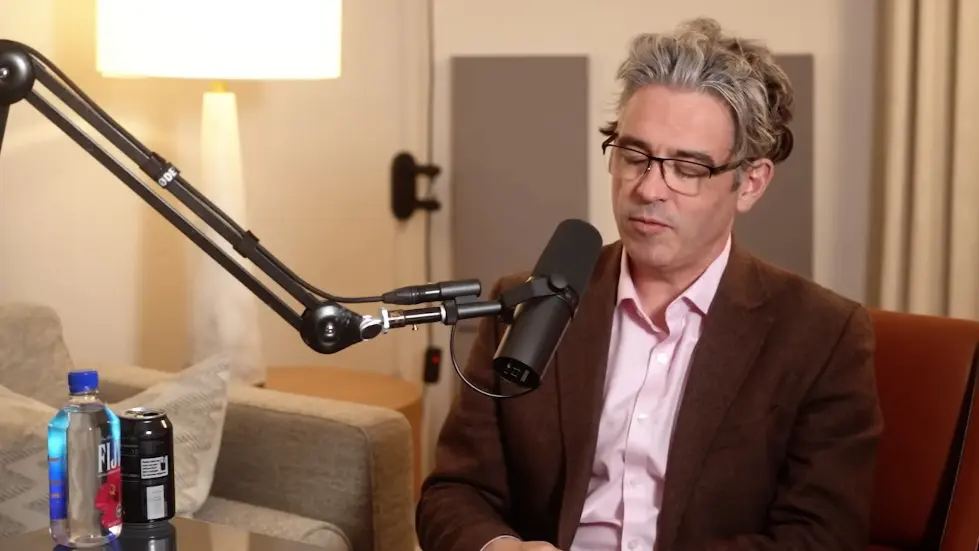
- The building process is not sequential, but can be done in parallel.
- The assembly index is the minimum number of steps required to add the parts of an object together to reproduce it.
- Assembly depth can be lower than the assembly index for a molecule when they're cooperating together.
- Nature needs to make compromises when it's making molecules in a cell.
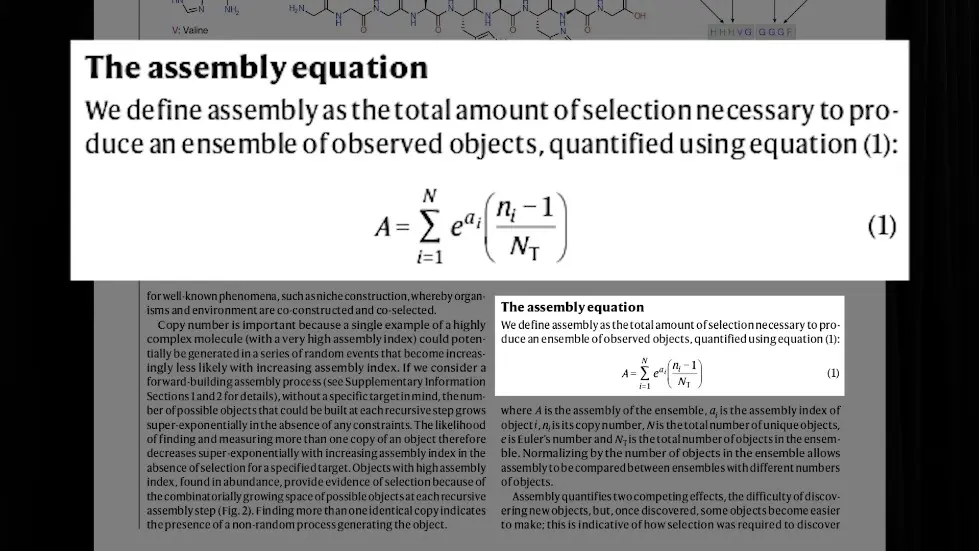
- The paper defines assembly as the total amount of selection necessary to produce an ensemble of observed objects.
Assembly Equation
- The assembly equation is one side which is the Assembly of The Ensemble MH and then a sum from one to n where n is the total number of unique objects.
- There are variables in the equation that include the assembly index, copy number, and normalization.
- The assembly index is an interesting addition that has to do with what that you can create pretty complex objects randomly.
- The normalization is used to make sure that more than one object one object could be one of and random.
- When there's two of a thing two of a thing is super important especially if the IND index assembly index is high.

Selection and Evolution
- The paper annoyed some people, including evolutionary biologists and physicists.
- The evolutionary biologist got angry because they thought Evolution biologies would be cool.
- The physicist got grumpy because the initial conditions tell everything.
- The creationist said it wasn't creationist enough.
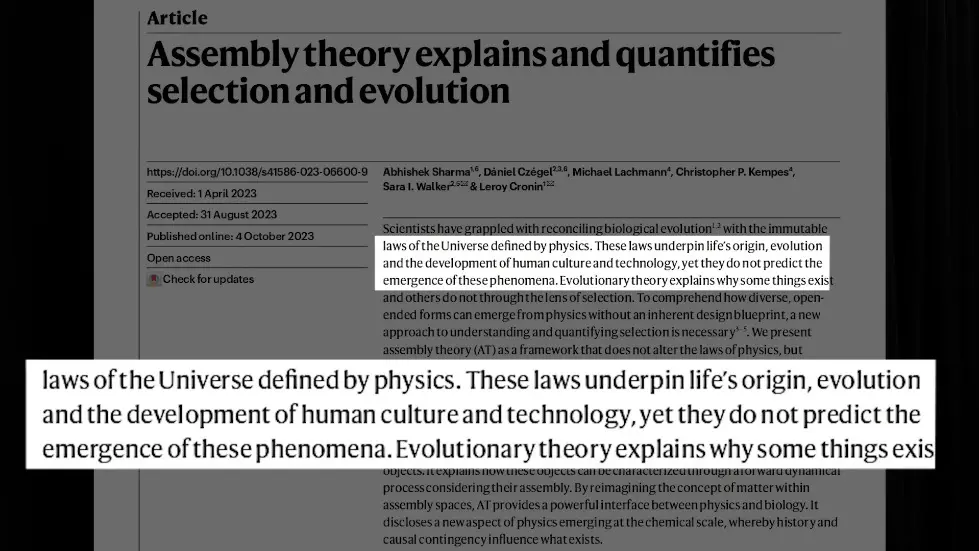
- The reason why people put the phone down on the call of the paper is that it grappled with reconciling biological evolution with the immutable laws of the universe defined by physics.
Introduction
- The paper "Assembly Theory: Explains and Quantifies Selection and Evolution" was accepted and published in Nature.
- The paper presents interesting ideas but reaches a high level of controversy.
- The paper was on the pre-print server for over a year.
- The author does not regret anything and thinks the paper was well-written.
- The paper discusses the assembly theory in more detail, including the assembly index, which is the minimum number of steps required to add the parts of an object together to reproduce it.

The Assembly Theory
- The assembly theory explains and quantifies selection and evolution.
- The laws of physics are really cool, but they don't really explain the origin of life.
- Physicists might go "Yeah, there's this you know it's not just we can't just go back and say that's what happened because physics can't explain the origin of life yet."
- Intelligent designers might also be considered, but the paper focuses on non-biological selection and evolution.

Evolution and Selection
- Evolution works, but we don't know how it got going.
- Biological evolution and biological selection are not the only ways to explain selection and evolution.
- Many evolutionary biologists dismiss the origin of life questions.
- The paper suggests that there is a disconnect between physics and biology.

The Assembly Index
- The assembly index is the minimum number of steps required to add the parts of an object together to reproduce it.
- The assembly index can be used to quantify the complexity of an object.
- The history of an object is part of what is used to describe its complexity.
- The assembly index can help determine if an object was built by a process similar to evolution.

The Assembly Theory
- The assembly theory is a new theory about the evolution of life and the universe.
- It suggests that the complexity of objects in the universe can be quantified by trying to find the number of steps it took to create them.
- This can help determine if they were built by a process similar to evolution.
- The theory also suggests that the set of constraints to construct an object from its elementary building blocks is quantifiable.
- The history of an object is part of what is used to describe its complexity.

Discovery and Production Time
- Discovery time is the time when an object is discovered if it's say a molecule that can then act on itself or the chain of events that caused itself to bolster its formation.
- Production time is the time when more of it in the universe so it could be a self-replicating molecule and the interaction of the molecule in the environment in the War Little Pond or in the sea or wherever in the bubble could then start to build a Proto Factory the environment so really to answer your question what the factory is the factory is the environment but it's not very autonomous it's not very redundant.

Robustness and Selection
- Robustness is the ability to propagate over over in the the ability to survive in lots of different environments.
- Selection and evolution is robust that you have error correction built in you have really you know there's good ways of basically making sure propagation goes on so really the difference between inorganic selection Evolution and evolution and stuff in biology is robustness.
- Inorganic molecules are not robust and die in lots of different environments.
- Evolution and cells can survive everywhere.
- The difference between inorganic and organic selection and evolution is the ability to survive in different environments.

The History of Environments on Earth
- The paper could be very wrong but it's less wrong than some other ideas.
- If the assembly equation is not only meant to identify at the higher end Advanced selection what you get I would call in biology you super Advanced selection.
- Even the assembly equation could be used to look for technology.
- The real power of the assembly equation is to say how much selection is going on in this space.
- A thought experiment could be done by putting simple food in a petri dish and measuring the assembly in the amount of assembly in the box.

The Emergence of Molecular Networks
- The paper tries to make those kind of experiments and see if we can spot the emergence of molecular networks are producing complexity as we feed in raw materials and we feed a challenge an environment.
- The main kind of idea for the entire paper is to see if you can measure the changes in the assembly index throughout the whole system.
- If you show up to a new planet, you could measure the changes in the assembly index to determine if there is life on the planet.

Section 1: Introduction to Assembly Theory
- The video discusses a controversial paper published in Nature by chemist Lee Cronin, which proposes a new theory about the evolution of life and the universe.
- The theory suggests that the complexity of objects in the universe can be quantified by trying to find the number of steps it took to create them.
- This can help determine if they were built by a process similar to evolution.
- The set of constraints to construct an object from its elementary building blocks is quantifiable, and the history of an object is part of what is used to describe its complexity.

Section 2: Assembly Index
- The assembly index is the minimum number of steps required to add the parts of an object together to reproduce it.
- To determine the assembly index of a molecule, you need to select a molecule from the mass and then fragment it.
- The number of fragments and the molecular weight are used to calculate the assembly index.
- A higher assembly index indicates a more complex object.

Section 3: Finding Artifacts on Mars
- To find artifacts on Mars that could only be produced by life, you need to use a mass spectrometer with a sufficiently high resolution.
- You can count the number of identical copies of a molecule and then fragment them to determine the assembly index.
- If you find a molecule with a high assembly index, it could be evidence of life on Mars.
- The geological process is not the only explanation for the presence of complex molecules on Mars.

Section 4: Copy Number and Complexity
- The copy number is the number of identical copies of a molecule.
- The copy number is important because it implies structure.
- A factory operating under a selection process is an example of a structure that implies complexity.
- The copy number is indistinguishable from ultimate randomness and ultimate complexity until you can see a structure in the randomness.

Section 1: Introduction to Emojis and Language
- The video discusses the concept of emojis and how they are used to convey meaning in language.
- The speaker mentions the mathematical theorems that underlie the use of emojis and how they can be used to convey complex ideas in a simple way.
- The speaker also discusses the idea of assembly theory and how it can be used to understand the complexity of objects.

Section 2: Assembly Theory and Complexity
- The video explains how assembly theory can be used to quantify the complexity of objects by trying to find the number of steps it took to create them.
- The speaker mentions the assembly index, which is the minimum number of steps required to add the parts of an object together to reproduce it.
- The video also discusses how the history of an object is part of what is used to describe its complexity.

Section 3: Planetary Exploration and Search for Primitive Life
- The speaker discusses how to search for primitive life on planets like Mars, Titan, and Enceladus.
- The speaker mentions the idea of taking a large scoop or going for the atmosphere to detect life.
- The speaker also discusses the use of a mass spectrometer to detect complex molecules and find evidence of life.

Section 4: Life Meter and Complexity Detection
- The speaker mentions the idea of a life meter, which is a device used to detect the complexity of living systems.
- The speaker discusses how the life meter can be used to detect complex molecules and find evidence of life.
- The speaker also discusses the idea of drilling down into the soil to find complex molecules in harsh environments.

Introduction
- The video is about a controversial paper published in Nature by chemist Lee Cronin, which proposes a new theory about the evolution of life and the universe.
- The paper suggests that the complexity of objects in the universe can be quantified by trying to find the number of steps it took to create them, and that this can help determine if they were built by a process similar to evolution.
- The theory also suggests that the set of constraints to construct an object from its elementary building blocks is quantifiable, and that the history of an object is part of what is used to describe its complexity.

Assembly Theory
- The video discusses the assembly theory in more detail, including the assembly index, which is the minimum number of steps required to add the parts of an object together to reproduce it.
- The video also touches on the controversy surrounding the paper and the interesting discussions it has generated.

Controversy
- The paper has been controversial due to its claims about the complexity of objects in the universe and their potential evolutionary origins.
- Some scientists have criticized the paper for lack of experimental evidence and for relying too heavily on mathematical models.
Conclusion
- Overall, the video provides an overview of the assembly theory and its potential applications in understanding the complexity of objects in the universe.
- It also highlights the controversy surrounding the paper and the ongoing discussions about its implications.

The Video
- The video is about a controversial paper published in Nature by chemist Lee Cronin, which proposes a new theory about the evolution of life and the universe.
- The paper suggests that the complexity of objects in the universe can be quantified by trying to find the number of steps it took to create them, and that this can help determine if they were built by a process similar to evolution.
- The theory also suggests that the set of constraints to construct an object from its elementary building blocks is quantifiable, and that the history of an object is part of what is used to describe its complexity.
- The video discusses the assembly theory in more detail, including the assembly index, which is the minimum number of steps required to add the parts of an object together to reproduce it.
- The video also touches on the controversy surrounding the paper and the interesting discussions it has generated.

Assembly Theory
- Assembly theory is a new theory about the evolution of life and the universe, proposed by chemist Lee Cronin.
- The theory suggests that the complexity of objects in the universe can be quantified by trying to find the number of steps it took to create them.
- This can help determine if they were built by a process similar to evolution.
- The set of constraints to construct an object from its elementary building blocks is also quantifiable.
- The history of an object is part of what is used to describe its complexity.

Assembly Index
- The assembly index is the minimum number of steps required to add the parts of an object together to reproduce it.
- It is used to quantify the complexity of an object.
- A higher assembly index means that the object is more complex.
- The assembly index can be used to compare the complexity of different objects.
- It is a key concept in assembly theory.

Controversy
- The paper has generated a lot of controversy and interest.
- Some people are skeptical of the theory and its implications.
- Others are excited about the potential for new insights into the evolution of life and the universe.
- The paper has sparked a lot of discussion and debate in the scientific community.
- It is likely that the paper will continue to be studied and debated for years to come.

Section 1: Introduction
- The video is about a controversial paper published in Nature by chemist Lee Cronin, which proposes a new theory about the evolution of life and the universe.
- The paper suggests that the complexity of objects in the universe can be quantified by trying to find the number of steps it took to create them, and that this can help determine if they were built by a process similar to evolution.
- The theory also suggests that the set of constraints to construct an object from its elementary building blocks is quantifiable, and that the history of an object is part of what is used to describe its complexity.

Section 2: Assembly Theory
- The video discusses the assembly theory in more detail, including the assembly index, which is the minimum number of steps required to add the parts of an object together to reproduce it.
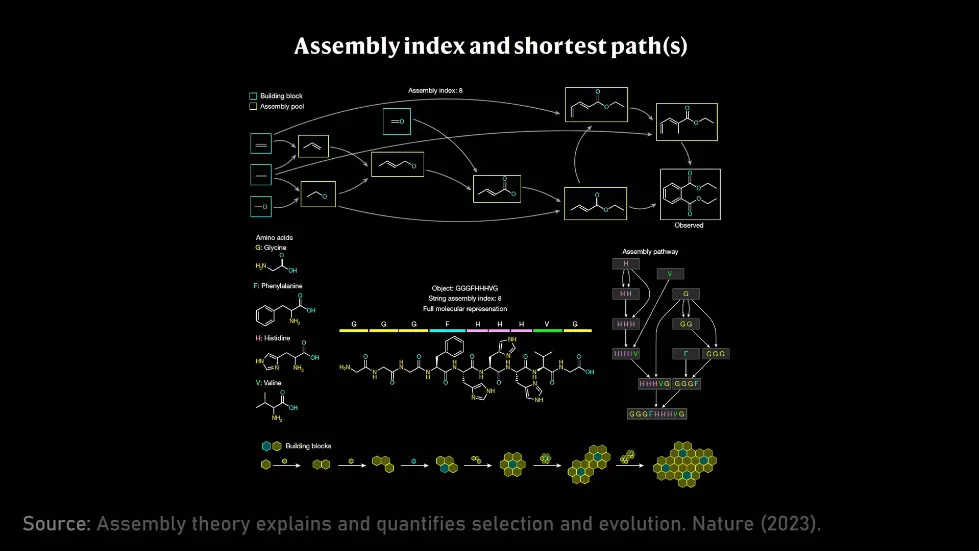
- The assembly index is calculated by fragmenting the molecules in a sample and counting the number of assembly space fragments that are created.
- The assembly index can be used to infer common origins of molecules and look at what's called The Joint assembly space.

Section 3: Experiment
- The video explains how the assembly theory can be applied in an experiment. A sample is taken and fragmented, and the top say 10 molecules are fragmented and their assembly indices are calculated.
- By comparing the assembly indices of different samples, it is possible to determine if they are the same or different, which can give information about their evolutionary relationships.

Section 4: Applications
- The video discusses the potential applications of the assembly theory, including the ability to recapitulate the tree of life from no sequencing and to find new forms of life that are no longer able to be sequenced.
- The assembly theory can also be used to date the death of organisms by looking at the rate of decomposition of their molecules.

The Evolution of Life and the Universe
- The paper proposes a new theory about the evolution of life and the universe.
- The complexity of objects in the universe can be quantified by trying to find the number of steps it took to create them.
- This can help determine if they were built by a process similar to evolution.
- The set of constraints to construct an object from its elementary building blocks is quantifiable.
- The history of an object is part of what is used to describe its complexity.

Assembly Theory
- The assembly theory is a way of understanding how objects are built from their elementary building blocks.
- The assembly index is the minimum number of steps required to add the parts of an object together to reproduce it.
- The more complex a molecule, the more prospect for decomposition, oxidation, and loss of chirality.
- Life enriches as it gets older, increasing the amount of carbon 13 in the body.
- The kinetic isotope effect is a phenomenon where the bonding in carbon 13 is slightly different, which can be used to estimate the age of a living organism.
Controversy Surrounding the Paper
- The paper has generated a lot of interest and controversy.
- Some people have criticized the paper for being poorly written.
- Evolutionary biologists have criticized the paper for solving a problem that they thought was already solved.
- Physicists have been polite but have raised questions about the initial conditions of the universe.
- Assembly theory shows why the origin of life cannot be encoded in the initial conditions of the universe.

The Assembly Theory
- The assembly theory is a new theory about the evolution of life and the universe.
- It suggests that the complexity of objects in the universe can be quantified by trying to find the number of steps it took to create them.
- This can help determine if they were built by a process similar to evolution.
- The set of constraints to construct an object from its elementary building blocks is quantifiable.
- The history of an object is part of what is used to describe its complexity.

The Assembly Index
- The assembly index is the minimum number of steps required to add the parts of an object together to reproduce it.
- It is not obvious and no one had measured it before.
- It is a first stab at quantifying the complexity of objects.
- It is a tribute to all people who understand that biology does something interesting but have not yet quantified it.
- It plucked two strings at once, it plucked the idea that biology is interesting but have not yet quantified it.

Criticism of the Assembly Theory
- The origin of life is understood and does not require an explanation that involves physics.
- Some people were rude and spiteful in their criticism.
- The evolutionary biology community was vocal in their criticism.
- The assembly theory is a bold claim that is precise and testable.
- It is not a wooly information in biology argument.

The Impact of the Assembly Theory
- The assembly theory has the potential to change the way we look at biology and the universe.
- It is a concrete series of statements that can be falsified and explored.
- It is a tribute to all people who understand that biology does something interesting but have not yet quantified it.
- It is a first stab at quantifying the complexity of objects.
- It is a bold claim that is precise and testable.

Section 1: Introduction to Assembly Theory
- The video discusses a controversial paper published in Nature by chemist Lee Cronin, which proposes a new theory about the evolution of life and the universe.
- The theory suggests that the complexity of objects in the universe can be quantified by trying to find the number of steps it took to create them.
- This can help determine if they were built by a process similar to evolution.
- The set of constraints to construct an object from its elementary building blocks is quantifiable, and the history of an object is part of what is used to describe its complexity.

Section 2: Assembly Theory and Tissue Types
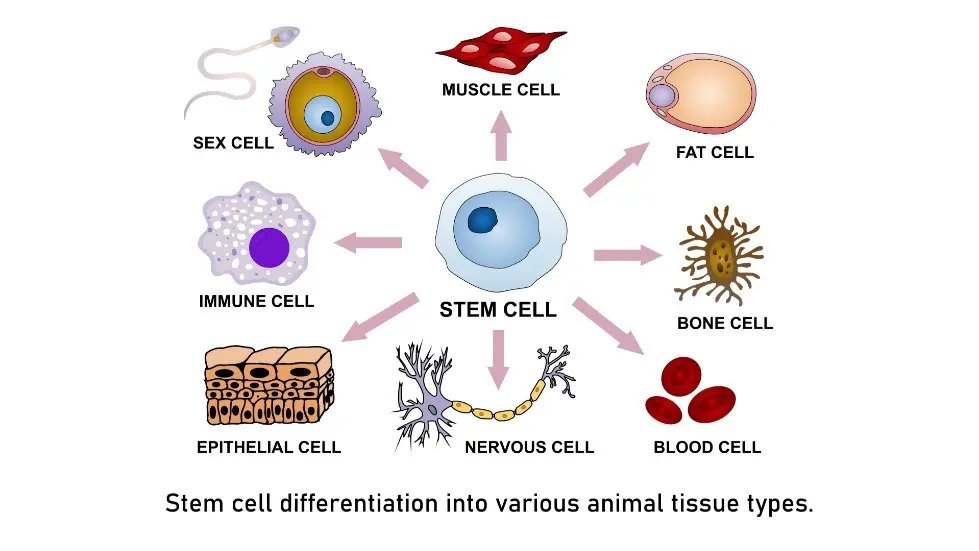
- The video discusses how assembly theory can be applied to tissue types, including different cell disease types.
- The theory can be used to walk through the development of an organism in time, from the initial cell to the final product.

Section 3: Assembly Theory and Emergence
- The video discusses how assembly theory can be applied to hierarchies of emergence, such as the human brain.
- The assembly index of a human brain can be used to compare it to other brains, such as those of whales or chimpanzees.
- The copy number is just the number of the specific brain being compared.
- To discover the features that should be looked for, an idea of the anatomy is needed.

Section 4: Assembly Theory and Compression
- The video discusses how compression can be used as a measurement of the assembly index and copy number.
- The assembly universe is the concept of all possible brains, features, and time.
- The jump from assembly possible to assembly contingent is the key to understanding the development of living organisms.
- Assembly theory can be used to show the increase in the assembly index associated with cultures or pieces of text like language or images.

Section 1: Clean Observables and Assembly Theory
- The video discusses the concept of clean observables and assembly theory.
- Clean observables are properties of a system that can be measured without affecting the system.
- Assembly theory is a method for understanding the complexity of objects by trying to find the number of steps it took to create them.
- The video suggests that assembly theory can be used to understand the evolution of life and the universe.
- The theory proposes that the complexity of objects in the universe can be quantified by trying to find the number of steps it took to create them.

Section 2: Assembly Index and Evolution
- The assembly index is the minimum number of steps required to add the parts of an object together to reproduce it.
- The video discusses the assembly index in more detail, including its relationship to evolution.
- The theory suggests that the history of an object is part of what is used to describe its complexity.
- The video touches on the controversy surrounding the paper and the interesting discussions it has generated.
- The video suggests that assembly theory is great for understanding where evolution has been used, but the next jump is when we go to technology.
Section 3: Large Language Models and Assembly Theory
- The video discusses the use of assembly theory in understanding large language models.
- The large language models come from all the people that produced all the language and that's really interesting.
- The corrections in the large language model come from the Mechanical Turk, which is part of the history part of the memory of the system.
- The video suggests that it would be interesting to use an assembly-based approach to making language in a hierarchy.
- The video suggests that it might be possible to build a new type of large language model that uses assembly theory and has more understanding of the past and how things were created.

Section 4: Intelligence and Assembly Theory
- The video discusses the relationship between intelligence and assembly theory.
- The video suggests that selection is intelligence, but human beings have the ability to abstract and break beyond selection.
- The video suggests that assembly theory will measure that as well, because it's all a lineage.
- The video suggests that assembly theory will measure the complexity of an object by trying to find the number of steps it took to create it.
- The video suggests that assembly theory will measure the complexity of an object by tracing the process by which life and evolution emerged.

Introduction
- The video is about a controversial paper published in Nature by chemist Lee Cronin, which proposes a new theory about the evolution of life and the universe.
- The paper suggests that the complexity of objects in the universe can be quantified by trying to find the number of steps it took to create them, and that this can help determine if they were built by a process similar to evolution.
- The theory also suggests that the set of constraints to construct an object from its elementary building blocks is quantifiable, and that the history of an object is part of what is used to describe its complexity.

Assembly Theory
- Assembly Theory is a subset of complexity measures that looks at objects and tries to infer their history by looking for the shortest history.
- The main difference between Assembly Theory and other complexity measures is that there is no causal chain, meaning that the causal chain is at the core of Assembly Theory.
- If you have all your data in a computer memory, all the data is the same and you can access it in the same way. You either look at the program runtime or the shortest program.
- Assembly Theory allows you to say from this object how deep is this object in time if we just treat the object as itself without any other any other constraints.

Inferring History
- The shortest path is inferred from the object that is the worst case scenario if you have no machine to make it.
- This tells you about the depth of that object in time.
- Without considering any other circumstances, you can say from this object how deep is this object in time.
- Assembly theory is not meant to ignore the factory, it's just to say it's just to say hey there was a factory.

Computational Difficulty
- Computing the history of complex objects is computationally very difficult.
- It becomes harder one of the thing that's super nice is that um it constrains your initial conditions right it constrains where you're going to be.
- For example, in drug discovery, instead of thinking about and use the molecules evolve over time as a proxy for how the proteins evolved over time, you can focus on the molecule evolution.
- This allows you to guess in the future what might happen so you can constrain your drug discovery process.

The Assembly Theory
- The assembly theory is a new theory about the evolution of life and the universe.
- It suggests that the complexity of objects in the universe can be quantified by trying to find the number of steps it took to create them.
- This can help determine if they were built by a process similar to evolution.
- The set of constraints to construct an object from its elementary building blocks is quantifiable.
- The history of an object is part of what is used to describe its complexity.

The Assembly Index
- The assembly index is the minimal path that could have created an object probabilistically.
- It is defined as the quickest way to zip out a molecule with no reaction constraints.
- The time scale for forming the bonds is not important, as it is just a lower bound on the assembly process.
- Some reactions are less possible than others, but the assembly theory puts a lower bound on the assembly process.
- The assembly index is a useful tool for understanding the complexity of objects in the universe.

Chemical Reactions
- Chemical reactions exist as controlled by the laws of quantum mechanics.
- Reactions are constrained by the fact they are on planet Earth, 1G MH 298 K, and the chemical composition of Earth's oxygen and availability.
- When a chemist does a reaction, it is a compressed shorthand for constraint application.
- Bond energies are intrinsic in a vacuum, and for assembly theory to work, a bond is required that gives the molecule certain half-life.
- Some bonds are weaker and may be missed in mass spectrometry when counting the assembly of some molecules.

The Origin of Chemical Reactions
- The origin of chemical reactions is a topic of ongoing research.
- Reactions are constrained by the laws of quantum mechanics and the availability of reactants and products.
- Chemical reactions are not accessible on Venus, which is useful for framing the assembly theory in a larger context.
- The grammar of chemistry emerges in reactions and can be used reliably.
- The assembly theory is a useful tool for understanding the complexity of objects in the universe.

You have read 50% of the summary.
To read the other half, please enter your Name and Email. It's FREE.
You can unsubscribe anytime. By entering your email you agree to our Terms & Conditions and Privacy Policy.
Watch the video on YouTube:
Lee Cronin: Controversial Nature Paper on Evolution of Life and Universe | Lex Fridman Podcast #404 - YouTube
Related summaries of videos:
- Jeff Bezos: Amazon and Blue Origin | Lex Fridman Podcast #405
- Teddy Atlas: Mike Tyson, Cus D'Amato, Boxing, Loyalty, Fear & Greatness | Lex Fridman Podcast #406
- Guillaume Verdon: Beff Jezos, E/acc Movement, Physics, Computation & AGI | Lex Fridman Podcast #407
- Tal Wilkenfeld: Music, Guitar, Bass, Jeff Beck, Prince, and Leonard Cohen | Lex Fridman Podcast #408
- Matthew Cox: FBI Most Wanted Con Man - $55 Million in Bank Fraud | Lex Fridman Podcast #409
- Lisa Randall: Dark Matter, Theoretical Physics, and Extinction Events | Lex Fridman Podcast #403
- Michael Malice: Thanksgiving Pirate Special | Lex Fridman Podcast #402
- John Mearsheimer: Israel-Palestine, Russia-Ukraine, China, NATO, and WW3 | Lex Fridman Podcast #401
- Elon Musk: War, AI, Aliens, Politics, Physics, Video Games, and Humanity | Lex Fridman Podcast #400
- Jared Kushner: Israel, Palestine, Hamas, Gaza, Iran, and the Middle East | Lex Fridman Podcast #399
- Home
- About us
- Contact
- Book Summaries 0-9
- Book Summaries A
- Book Summaries B
- Book Summaries C
- Book Summaries D
- Book Summaries E
- Book Summaries F
- Book Summaries G
- Book Summaries H
- Book Summaries I
- Book Summaries J
- Book Summaries K
- Book Summaries L
- Book Summaries M
- Book Summaries N
- Book Summaries O
- Book Summaries P
- Book Summaries Q
- Book Summaries R
- Book Summaries S
- Book Summaries T
- Book Summaries U
- Book Summaries V
- Book Summaries W
- Book Summaries X
- Book Summaries Y
- Book Summaries Z
- Jay Shetty Podcast - Summaries
- Tom Bilyeu Impact Theory - Summaries
- Lex Fridman - Summaries
- Diary of a CEO - Summaries
- Alex Hormozi - Summaries
