
"EVERYTHING You Think You Know About Yourself Is WRONG!" (How To Find Yourself) | Mark Manson
Last updated: Jun 1, 2023
The video is about how our concept of ourselves is built from the narratives we create from our experiences, and how defining our values is important in shaping our identity.
The video features an interview with Mark Manson, the author of the best-selling book "The Subtle Art of Not Giving a F*ck" and his recent book "Everything is F*cked". Manson discusses the concept of identity and how it is built from the narratives we create from our experiences. He emphasizes the importance of defining our values and how they shape our actions and behaviors. Manson also talks about the malleability of values and how we can change them to improve our lives. The interview explores various topics related to self-help and personal development.
- Our concept of ourselves is built from the narratives we create from our experiences.
- Mark Manson is a best-selling author and founder of Infinity Squared Media.
- Values define our identity and are subjective and malleable.
- Defining our values is important in shaping our identity and living a fulfilling life.
- Choosing values is a conscious decision that starts with visualization.
- Trying on new values involves visualizing what it would mean for your life and mourning the loss of old values.
- Success should be defined based on internal factors like personal growth, relationships, and happiness.
- Reshaping ourselves involves letting go of old values and embracing new ones.
- Personalizing values and ethics is important for individual growth and improvement.

Our Concept of Ourselves is Built from Narratives
- Our concept of ourselves is built from the narratives we create from our experiences.
- Our idea of ourselves is just a vast collection of narratives that we've constructed around our own experiences.
- Our feeling brain has a certain valence for those experiences.
- If we want to change how we feel about ourselves, we have to start peeling back those layers of narrative.
- We have to start getting down into the deepest earliest ones because those are often the most impactful and influential.

Introduction to Mark Manson
- Mark Manson is the New York Times best-selling author of the international smash hit "The Subtle Art of Not Giving a [__]."
- His book sold millions of copies, was translated into 25 languages, and dominated the bestseller list for a staggering amount of time.
- He's also written for or been cited by some of the most prestigious outlets on the planet.
- Additionally, he's published hundreds of blog articles which are viewed by millions of people every month.
- He's the founder and CEO of Infinity Squared Media and the author of the recent book "Everything is [__]."

Values Define Our Identity
- Mark Manson's focus in his work has always been value-focused.
- He feels that in the self-help and self-development world, there's so much focus on success, but nobody's actually standing back and defining what success is.
- Deciding what we're choosing to define as success is a more important question than ever before.
- Essentially, what we are is just an aggregation of what we choose to value in this world.
- If we value money more than anything else, that will come to define us through our actions, behaviors, and what we invest our time and attention into.
- If we value family, that will define who we are because everything else will flow from that.

Values are Malleable
- People often act as if values are empirical truths.
- Values are not empirical truths, they are subjective and malleable.
- Values can change over time and can be influenced by our experiences and the narratives we create around them.
- It's important to regularly evaluate our values and make sure they align with who we want to be.
- Defining our values is important in shaping our identity and living a fulfilling life.
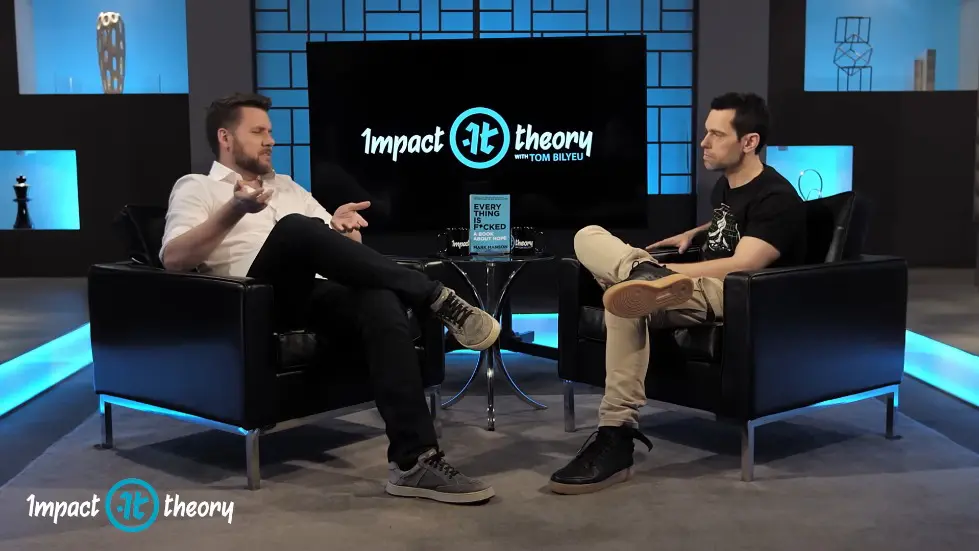
Choosing Your Values
- Our concept of ourselves is built from the narratives we create from our experiences.
- Defining our values is important in shaping our identity.
- Many people don't realize that their values are a choice often handed to them by the way they grew up and what their parents instilled in them.
- It's important to recognize that all of this is a choice that you can consciously decide what you're going to value.
- The process of deciding to value something is difficult, but it starts with visualization.

Trying on New Values
- Before you can commit to a new value, you have to try them on like trying on a bunch of pairs of clothes.
- The way you try on a new value is by sitting down and visualizing what it would mean for your life and what it would mean for you as a person if you didn't value what you currently value.
- It's a difficult question to ask because it messes us up and shakes up our understanding of ourselves.
- Most of the time, visualization is taught in the self-help industry as visualizing what you want and going to get it, but it's important to visualize not wanting what you currently desire.
- It's a process of mourning when you lose an important value or an important part of yourself because it feels like losing a girlfriend or losing a friendship.
Identity and Success
- Our identity begins to get tied up in our values and what we define as success.
- It's important to help people not succumb to the trap of defining success in a certain way.
- Many people define success based on external factors like money, status, or fame.
- It's important to define success based on internal factors like personal growth, relationships, and happiness.
- Success is a journey, not a destination, and it's important to enjoy the journey.

Reshaping Ourselves
- Our conception of who we are is just kind of this arbitrary imagined thing in our brain.
- Our relationship with ourselves is similar to our relationship with another human being.
- When we lose an important value or an important part of ourselves, we go through the same emotional process of grieving or mourning.
- Reshaping ourselves is a process of letting go of old values and embracing new ones.
- It's important to understand that our identity is not fixed and can be reshaped throughout our lives.

Defining Values and Ethics
- Being driven towards something without reflecting on its morality can be damaging.
- Defining values is important in shaping our identity.
- Self-improvement and ethics are connected.
- Questions around values are personal and cannot be answered by others.
- Pointing people in the right direction and helping them find their own answers is key.
Asking Better Questions
- Write down goals and ask why you want to achieve them.
- Write down things you're grateful for and ask why you're grateful for them.
- Question the good things in your life as well as the bad.
- Many things that feel good can actually be hurting you.
- Questioning is important in defining values and ethics.
Establishing a Framework
- Having a base belief is necessary for building a framework.
- Defining values is a good starting point.
- Reading philosophy can be helpful in defining values and ethics.
- Approaching life from a Buddhist perspective can also be helpful.
- Pointing people in the direction of defining their own values is key.

Personalizing Values and Ethics
- Questions around values are personal and cannot be answered by others.
- Defining values is important in shaping our identity.
- Pointing people in the direction of defining their own values is key.
- Personalizing values and ethics is important for individual growth and improvement.
- Helping people find their own answers is more important than giving them answers.

Defining Values
- Kant's moral philosophy has a principle called the formula of humanity.
- The principle is to always act in such a way that you never merely treat people as a means but always as an end.
- Don't use people for personal gain, and the end goal of what you do should always be a person.
- Lying, cheating, and stealing are examples of using people as a means to some other end.
- Being transactional in relationships screws them up.
Defining Success
- Success means creating a life and creating a world with better problems.
- Every experience in life has its associated problems.
- Instead of thinking about what benefits you want in life, think about what problems you want in life.
- Having a show on YouTube comes with a whole crew, logistics, and legal issues.
- Choosing the problems you want to have is what makes something successful.

Understanding Emotions
- Consciousness is like a car with a feeling brain and a thinking brain.
- Most people assume the thinking brain is responsible for driving, and the feeling brain is the bratty kid in the passenger seat.
- The job of the thinking brain is to keep two hands on the wheel and not let the feeling brain take over.
- Emotions are messy, and it's important to understand them to leverage them.
- Don't always trust your emotions, and learn to untangle the emotional knot.
Conclusion
- Defining values and understanding emotions are important in shaping our identity.
- Success is not just about achieving something but also about choosing the problems you want to have.
- Emotions are messy, and it's important to understand them to leverage them.
- Our concept of ourselves is built from the narratives we create from our experiences.
- Don't use people for personal gain, and always treat them as an end goal.

The Feeling Brain vs The Thinking Brain
- Our culture sees failure to control impulses and emotions as a failure of willpower and discipline.
- The feeling brain is actually driving the car, and it's a little bit crazy.
- The thinking brain is actually in the passenger seat, deluding itself into thinking it's driving.
- The power of the thinking brain is that we get to draw the map.
- We don't have total control over what's pushing us forward, but we do have control over the meaning and interpretation of our actions and emotions.

Getting the Two Brains to Talk to Each Other
- To develop a real sense of control in your life, it's not about beating your emotions into submission.
- You need to get the two brains to talk to each other, even though they speak different languages.
- Instead of trying to get your feeling brain to shut up, ask it how things make you feel.
- The thinking brain needs to negotiate with the feeling brain to get it pointed in the direction you want it.
- There are mental tricks to coax your emotions and leverage them to get the feeling brain pointed in the direction you want it.

You have read 50% of the summary.
To read the other half, please enter your Name and Email. It's FREE.
You can unsubscribe anytime. By entering your email you agree to our Terms & Conditions and Privacy Policy.
Watch the video on YouTube:
"EVERYTHING You Think You Know About Yourself Is WRONG!" (How To Find Yourself) | Mark Manson - YouTube
Related summaries of videos:
- This Was A KEPT SECRET By Monks! - Stop Wasting Your Life & Unlock Your POTENTIAL | Sadhguru
- This Is Terrifying: The True Cause of Heart Disease | Dr. Jack Wolfson on Health Theory
- The 1% DO THIS To Achieve Anything They Want! (START DOING THIS) | Patrick Bet David
- How to Quit Social Media and Master Your Focus | Cal Newport on Impact Theory
- This “Bodybuilding Yogi” Explains Why Mindset Trumps All | Ben Pakulski on Health Theory
- How to Instantly Achieve a Calm State | Sam Harris on Impact Theory
- If You Feel Fear or Anxiety, Listen to This | Trent Shelton on Impact Theory
- Brain Surgeon’s Advice On How To Stop Negative Behaviors And Strengthen Your Mind
- How BEING HUNGRY Helps You Prevent Disease, LOSE WEIGHT & End Inflammation! | Mike Mutzel
- The Quick Part is a Lie, But This Guy Will Teach You How to Get Rich | Ramit Sethi on Impact Theory
- Home
- About us
- Contact
- Book Summaries 0-9
- Book Summaries A
- Book Summaries B
- Book Summaries C
- Book Summaries D
- Book Summaries E
- Book Summaries F
- Book Summaries G
- Book Summaries H
- Book Summaries I
- Book Summaries J
- Book Summaries K
- Book Summaries L
- Book Summaries M
- Book Summaries N
- Book Summaries O
- Book Summaries P
- Book Summaries Q
- Book Summaries R
- Book Summaries S
- Book Summaries T
- Book Summaries U
- Book Summaries V
- Book Summaries W
- Book Summaries X
- Book Summaries Y
- Book Summaries Z
- Jay Shetty Podcast - Summaries
- Tom Bilyeu Impact Theory - Summaries
- Lex Fridman - Summaries
- Diary of a CEO - Summaries
- Alex Hormozi - Summaries
