
Robert Playter: Boston Dynamics CEO on Humanoid and Legged Robotics | Lex Fridman Podcast #374
Last updated: Jul 2, 2023
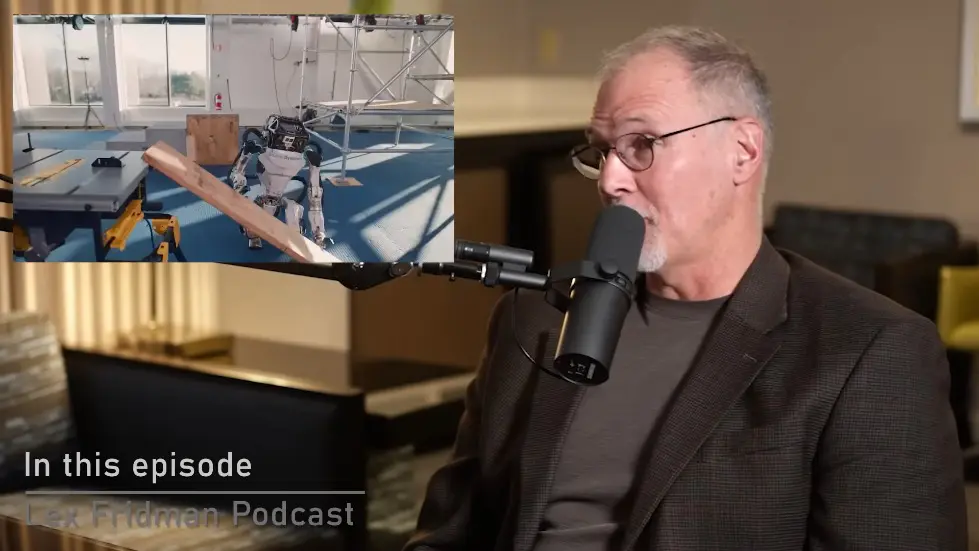
The video is about Robert Playter, CEO of Boston Dynamics, discussing the development of humanoid and legged robots. The company has been creating robots for over 30 years, including the humanoid robot Atlas and the robot dog Spot. Playter talks about the challenges of developing robots that can walk naturally and the importance of movement in robotics. He also discusses his own interest in gymnastics and how it influenced his appreciation for the elegance and beauty of movement.
This video by Lex Fridman was published on Apr 28, 2023.
Video length: 02:27:58.
The video is about Robert Playter, CEO of Boston Dynamics, discussing the development of humanoid and legged robots.
The company has been creating robots for over 30 years, including the humanoid robot Atlas and the robot dog Spot. Playter talks about the challenges of developing robots that can walk naturally and the importance of movement in robotics. He also discusses the elegance and beauty of movement and how it is grounded in his appreciation of gymnastics.
The video highlights the company's progress in developing robots and the importance of continued research and development in the field of robotics.
- Boston Dynamics is a company that has been creating robots for over 30 years.
- The CEO of Boston Dynamics, Robert Playter, talks about the challenges of developing robots that can walk naturally.
- Playter discusses his own interest in gymnastics and how it influenced his appreciation for the elegance and beauty of movement.
- The company has a value of simplifying a thing to its core essence.
- Playter talks about the approach of controlling robots, which is changing and becoming more broadly available.
- Boston Dynamics has developed some of the most elegant and dexterous robots ever built.
- Playter is inspired by the company's focus on physics-based simulation software and its ability to create elegant and dexterous robots.
- The development of humanoid robots like Atlas is a testament to the company's dedication to creating robots that can walk naturally.
- Playter's background in robotics and his interest in gymnastics have influenced his appreciation for the elegance and beauty of movement.
Introduction
- The video is about Robert Playter, CEO of Boston Dynamics, discussing the development of humanoid and legged robots.
- Boston Dynamics has been creating robots for over 30 years, including the humanoid robot Atlas and the robot dog Spot.
- Playter talks about the challenges of developing robots that can walk naturally and the importance of movement in robotics.
- He also discusses his own interest in gymnastics and how it influenced his appreciation for the elegance and beauty of movement.

Early Development of Humanoid Robots
- Boston Dynamics' early machine, called the Petman prototype, was developed before the Pac-Man robot.
- The Petman prototype had a nice-looking gate where the robot would extend its leg and do a heel strike before rolling onto the toe.
- Getting the robot to walk where it fully extended its leg was a long and difficult process.
- It took 10 to 15 years to develop the control algorithm for the robot to walk naturally.
- The Petman prototype was probably in 2008 and the team saw a good walking on Atlas in 2022.

Development of Atlas
- Atlas is a newer generation of Boston Dynamics' humanoid robot.
- The team developed new techniques for developing a walking control algorithm.
- Atlas was able to achieve natural-looking motion as a byproduct of the new process.
- It took 15 years to develop the walking control algorithm for Atlas.
- Atlas was able to walk naturally in 2022.

Robert Playter's Background and Interest in Robotics
- Robert Playter is CEO of Boston Dynamics and has been with the company from the beginning.
- He received his PhD in Aeronautical Engineering from MIT in 1994.
- His PhD thesis was on robot gymnastics, and he programmed a bipedal robot to do the world's first 3D robotic somersault.
- Playter is a great engineer and assistant leader at Boston Dynamics.
- He is inspired by the company's focus on physics-based simulation software and its ability to create elegant and dexterous robots.

Conclusion
- Boston Dynamics has been creating robots for over 30 years and has developed some of the most elegant and dexterous robots ever built.
- Playter is inspired by the company's focus on physics-based simulation software and its ability to create elegant and dexterous robots.
- The development of humanoid robots like Atlas is a testament to the company's dedication to creating robots that can walk naturally.
- Playter's background in robotics and his interest in gymnastics have influenced his appreciation for the elegance and beauty of movement.
- The development of humanoid robots like Atlas is a testament to the company's dedication to creating robots that can walk naturally.

Introduction
- The video is about Robert Playter, CEO of Boston Dynamics, discussing the development of humanoid and legged robots.
- The company has been creating robots for over 30 years, including the humanoid robot Atlas and the robot dog Spot.
- Playter talks about the challenges of developing robots that can walk naturally and the importance of movement in robotics.
Efficiency and Control
- Playter discusses the importance of efficiency in robotics, allowing the body to do what it wants to do.
- He explains that trying to discover the efficient movement of a robot can make it easier to control in its own way.
- Playter mentions that the physics of the body can stabilize mechanisms simply by virtue of its own movement.
- He notes that not all control and stability mechanisms need to be in the computer or the mind of the person.
Cutting Edge Work
- Playter talks about the cutting edge work being done in robotics and artificial intelligence.
- He mentions that he learned valuable lessons from Mark, such as pursuing one's interests and curiosity.
- Playter notes that people who work in robotics labs are often some of the happiest people he has met.
- He attributes this happiness to the fulfilling nature of bringing a thing to life and the physical interaction with robots.
Physical Interaction
- Playter discusses the unique aspect of physical interaction with robots, which can help people identify with them.
- He notes that this physical interaction is a source of happiness for many people.
- Playter mentions that physical interaction with robots is a unique aspect of the kinds of robots they are building.
- He notes that this physical interaction can help people connect with the robot and its purpose.
Conclusion
- Playter reflects on the many years he worked with Mark and the lessons he learned from him.
- He emphasizes the importance of having the courage of one's convictions and pursuing big problems.
- Playter notes that the development of humanoid and legged robots is a cutting edge field with many opportunities for innovation.
- He encourages others to pursue their interests and passions in robotics and artificial intelligence.

Boston Dynamics and Legged Robotics
- Boston Dynamics is a company that has been creating robots for over 30 years, including the humanoid robot Atlas and the robot dog Spot.
- The CEO of Boston Dynamics, Robert Playter, talks about the challenges of developing robots that can walk naturally and the importance of movement in robotics.
- Playter discusses his own interest in gymnastics and how it influenced his appreciation for the elegance and beauty of movement.
- The company has a value of simplifying a thing to its core essence, which was not easy in the early days and required expertise in understanding the dynamics of motion and feedback control principles.
- Playter talks about the approach of controlling robots, which is changing and becoming more broadly available, but at the time there weren't many groups who could work at a principled level with both the software and hardware.
The Early Days of Boston Dynamics
- Boston Dynamics was founded over 30 years ago.
- The company has been creating robots for over 30 years, including the humanoid robot Atlas and the robot dog Spot.
- The CEO, Robert Playter, talks about the challenges of developing robots that can walk naturally.
- Movement is an important aspect of robotics and is a core part of Boston Dynamics' work.
- The company is more focused on developing scientific principles that can be applied to different types of machines.
Humanoid Robots
- When Boston Dynamics started to pursue humanoid robots, there was so much complexity in the machine.
- Humanoid form provides some intuition about how it should look while it's moving.
- Articulating exactly what a humanoid robot is doing can be difficult.
- There is a receiving the motion at a rate that is sometimes hard to put into words.
- People are attracted to the machines Boston Dynamics builds because the inherent dynamics of movement are closer to right.
Elegance and Efficiency
- Elegance and efficiency are key aspects of movement in robotics.
- Early robots were so cautious in the way they moved that it looked inefficient.
- Dynamic stability and a lightweight machine are important for expressing the physics of movement in a robot.
- Getting the physics right can make a robot more efficient and stable in the long run.
- A robot that can walk stably over a wider range of conditions is more beautiful and attractive.
The Development of Humanoid Robots
- Boston Dynamics is more focused on developing scientific principles that can be applied to different types of machines.
- The company is working on developing a core set of principles like a spring-mass bouncing system that can be applied from a one-legged machine to a two or four-legged machine.
- The CEO, Robert Playter, talks about the challenges of developing robots that can walk naturally.
- Movement is an important aspect of robotics and is a core part of Boston Dynamics' work.
- The company is more focused on developing scientific principles that can be applied to different types of machines.

Challenges of Developing Robots that Can Walk Naturally
- Developing robots that can walk naturally is a challenging task.
- The first humanoid robot, Petman prototype, was developed to deliver natural looking walking.
- It took a long time to develop a walking control algorithm that produced a natural looking motion.
- One of the challenges of developing robots that can walk naturally is dealing with singularities, mathematical single points where a leg cannot move in any direction.
- Having all the mathematics to deal with these singular configurations is one of the challenges faced in robotics.

Development of Atlas
- Atlas is a newer generation of humanoid robot developed by Boston Dynamics.
- The team developed new techniques for developing a walking control algorithm that produced a natural looking motion in Atlas.
- Atlas was able to walk naturally and perform complex tasks.
- The development of Atlas was a significant milestone in humanoid robotics.

Actuation and Control in Robotics
- Actuation and control are important aspects of robotics.
- Robots must be able to move in any direction they want, and this requires advanced control systems.
- The control systems must be able to handle complex calculations and deal with singular configurations.
- The development of advanced control systems is a significant challenge in robotics.

Understanding Natural Movement
- Understanding natural movement is important in robotics.
- Robots must be able to perform complex tasks and move naturally.
- The development of robots that can walk naturally requires a deep understanding of natural movement.
- The development of robots that can walk naturally is a significant challenge in robotics.

Size and Complexity in Robotics
- The size and complexity of robots can affect their ability to move naturally.
- Large robots, like Alice, have a humanoid form that is attractive but also presents challenges in terms of movement.
- The development of robots that can move naturally, regardless of their size and complexity, is a significant challenge in robotics.

Challenges in Developing Humanoid Robots
- Developing robots with human-like movement is challenging due to the complexity of maintaining balance and the interaction between the body and legs.
- Humanoid robots have big heavy legs that swing and affect the entire body, making them more complicated than quadruped robots.
- Explicit modeling of the stuff picked up is necessary, including the shape and weight distribution, as part of the planning process.
- Atlas, a recent video, throws heavy things and demonstrates the robot's ability to apply techniques to deal with heavy things in the world.
- The robot needs to have some idea or expectation of the weight and predict how to manage the body plus the heavy thing to maintain balance.

Tools for Developing Humanoid Robots
- Tools have been built to allow quicker development of new behaviors for the robot, reducing the time from six months to a matter of days.
- Explicit modeling of new things that the robot might need to pick up is possible with the tools developed.
- Generalization is important in some ways, while detailed attention is necessary in others, depending on the task and the shape of the object being picked up.
- The body of the robot is rigid, making it easier to throw objects with a center of mass that is easy to manage.
- Carrying another robot is a task that has not been done yet, but it is possible with the right tools and techniques.

Examples of Humanoid Robot Development
- Atlas, a recent video, demonstrates the robot's ability to throw heavy things and apply techniques to deal with heavy things in the world.
- A Christmas skit featuring two Spot robots holding up another Spot robot trying to put a bow on a tree is an example of carrying another robot.
Future of Humanoid Robot Development
- Carrying another robot is a task that has not been done yet, but it is possible with the right tools and techniques.
- The ability to create new behaviors for the robot is going to be a quicker process with the tools developed.

Section 1: Introduction to Atlas
- Boston Dynamics CEO Robert Playter discusses the development of humanoid and legged robots.
- The company has been creating robots for over 30 years, including the humanoid robot Atlas and the robot dog Spot.
- Playter talks about the challenges of developing robots that can walk naturally.
- He discusses his own interest in gymnastics and how it influenced his appreciation for the elegance and beauty of movement.

Section 2: Atlas's Jumping Abilities
- Playter talks about Atlas's ability to jump onto a box, which was a particularly impressive feat.
- He mentions that Atlas was able to jump onto a box that was a meter high or higher, while a human would struggle to do the same.
- Playter discusses the testing that was done to understand how high Atlas could jump.
- He mentions that there are videos of Atlas trying and failing, but they are fun to watch.

Section 3: Next Generation of Atlas
- Playter talks about the next generation of Atlas and how the actuators will get stronger.
- He mentions that some of the joints and motions will be stronger, and that testing will be necessary to understand how high Atlas can jump.
- Playter discusses the optimization techniques that are being used to improve Atlas's jumping abilities.
- He mentions that learning techniques are also being used to improve Atlas's jumping abilities.
Section 4: Conclusion
- Playter discusses the acceleration happening in the development of Atlas's jumping abilities.
- He mentions that the physics of jumping can be calculated using Newton's laws.
- Playter discusses the cool trick of a front somersault with a half twist, which Atlas has been able to perform.
- He mentions that the model predictive control allows the robot to adjust on the fly and solve for optimal trajectories.

Robotics and Movement
- The development of humanoid and legged robots is challenging due to the importance of movement in robotics.
- Robots that can walk naturally are difficult to create because they require a fixed momentum to still get from A to B.
- While in the air, a robot cannot apply an external force or torque, so its momentum cannot change.
- Breaking and redesigning robots is a strategy to improve their performance and reduce the risk of breaking them repeatedly.
- Through the breaking process, one learns a lot and improves not just how to make the backflip work but everything and how to build the machine better.
DARPA Robotics Challenge
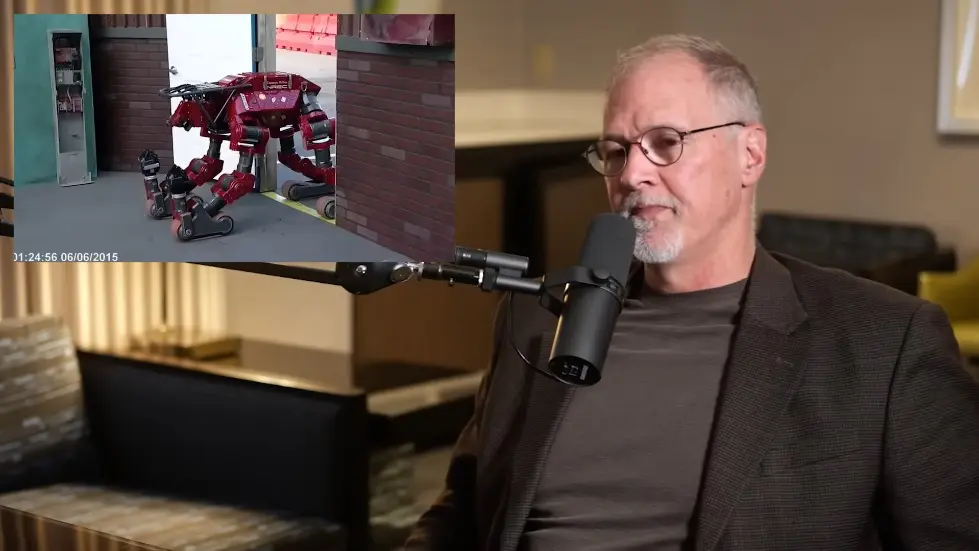
- The DARPA Robotics Challenge in 2015 was for people who are familiar with autonomous vehicles and humanoid robots.
- The challenge was to complete tasks such as manipulation, walking, driving, and identifying objects with limited communication capabilities.
- The contest was a follow-on to the Grand Challenge, which aimed to push vehicle autonomy forward.
- Boston Dynamics' role in the challenge was to build a humanoid robot, Atlas, which was their first generation robot.
- DARPA distributed 10 Atlas robots to various teams, and these teams competed against each other and other robots.
Backflips and Robotics
- The courage to try a backflip with a large body is necessary to make it work.
- Breaking and redesigning robots repeatedly is a strategy to improve their performance and reduce the risk of breaking them.
- The guts to come up with an idea to make a robot do a backflip is also important.
- The backflip is just one of many incredible things that can be achieved with robotics.
- The DARPA Robotics Challenge in 2015 was a significant event in the development of humanoid robots and their capabilities.

Robotics and Communication
- Humanoid robots in the DARPA Robotics Challenge were tasked to do all kinds of manipulation, walking, driving, and other challenges with limited communication capabilities.
- The communication between the robots and humans was very poor, and the robots had to be almost entirely autonomous.
- High-level guidance could be provided to the robots, but the communication was interrupted periodically.
- The contest was a significant challenge for the roboticists involved, requiring many years of hard work and millions of dollars.
- The contest was a follow-on to the Grand Challenge, which aimed to push vehicle autonomy forward.

Robotics and Movement
- The video is about Robert Playter, CEO of Boston Dynamics, discussing the development of humanoid and legged robots.
- The company has been creating robots for over 30 years, including the humanoid robot Atlas and the robot dog Spot.
- Playter talks about the challenges of developing robots that can walk naturally and the importance of movement in robotics.
- He discusses his own interest in gymnastics and how it influenced his appreciation for the elegance and beauty of movement.

Robot Competition
- Boston Dynamics provided the robot and some baseline software but did not compete as a participant in the robot maze competition.
- The goal of the contest was to push the industry forward and understand what is difficult and what is not.
- Atlas is a general robot platform that is perhaps not best suited for specific tasks like getting in and out of a car.
- The robot was a little big to get in and out of the car, which is the curse of a general-purpose robot that is not perfect at any one thing.
General Purpose Robots
- The goal at the end of the day is to build general-purpose robots that can be used for lots of different activities.
- Successful robots up until this point have been built for specific tasks and operate perfectly in controlled environments.
- Robots need to be able to deal with uncertainty if they are going to be useful in the future.
- Some of the failures in robotics are curious little moments that we and I would take for granted and deal with the robots don't know how to deal with yet.
Robot Control
- Model predictive control is used to predict what is going to happen and then if that does happen, you're in good shape if something else happens, you better start predicting again.
- Fast feedback loops of updating what your prediction how it matches to the actual real world are required.
- Things have to run pretty quickly, with a thousand Hertz of acting and sensing.
- There are different layers of this, including measuring position or force and trying to control the robot's joints.
Section 1: Actuator Control
- The actuator is a device that controls the force coming out of it.
- The actuator can be hydraulic or electric and is used to control the movement of the robot.
- The speed of the actuator is important and can range from 100 Hz to 1000 Hz.
- The amount of calculation that can be done is increasing as computers get better.
- A more complex model can be used to do forward prediction and make better predictions as the model gets better.

Section 2: Software Engineering
- The software pipeline is an important part of building a team around the robot.
- Simulation tools are used to test the robot in a virtual environment before putting it on the real robot.
- The code that is used in simulation must be the same code that is used on the hardware.
- Realistic simulation physics-based simulation of Atlas is difficult to achieve.
- The root of some of the physics-based simulation tools started at MIT.

Section 3: Physics-Based Simulation Tools
- Physics-based simulation tools are used to model the interaction between the robot and the world.
- Interaction with the world, such as foot ground contact, is an important element to model accurately.
- The simulation must be computationally feasible and run fast to avoid delays for developers.
- Developing physics-based simulation tools in parallel to the development of the platform is essential.
- Scaling the simulation tools is necessary to assemble a team of people that can simulate contact periods and manipulation.

Section 4: Atlas Robot Development
- The Atlas robot is a humanoid robot developed by Boston Dynamics.
- The robot has four modern Atlas robots at the company and 40 developers trying to gain access to it.
- The software pipeline is used to manage the development of the robot and share resources among developers.
- Realistic simulation physics-based simulation of Atlas is a challenging task.
- The dream is to have a simulation that works perfectly in reality, but it is difficult to achieve.
Challenges of Developing Robots with Natural Movement
- Developing robots that can walk naturally is a complex task.
- Capturing movement in robotics is important.
- Robots need to be able to handle slipping and moving in their hand.
- The level of complexity in robotics goes beyond foot-ground contact.
- Dexterous manipulation adds to the complexity of robotics.

Robots on Sand and Beaches
- Atlas, the humanoid robot, is not yet able to walk on sand and drink a beer.
- It is possible to take robots outside often, even on rocks and hills.
- Boston Dynamics has not yet taken Atlas to the beach.
- Robots can walk on sand, but it may require some adjustments.
- Salt surfaces can be challenging for robots, but they can be dealt with.
Robotics Challenges
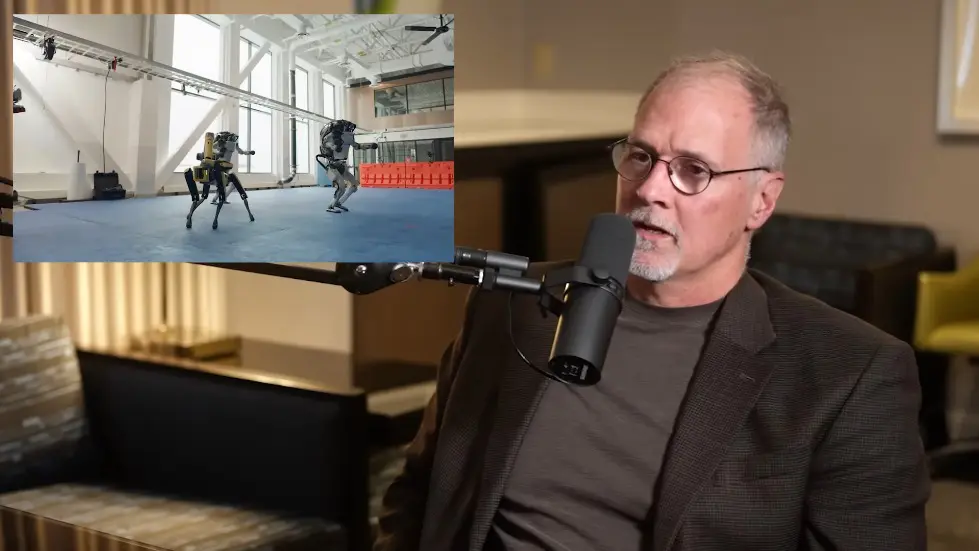
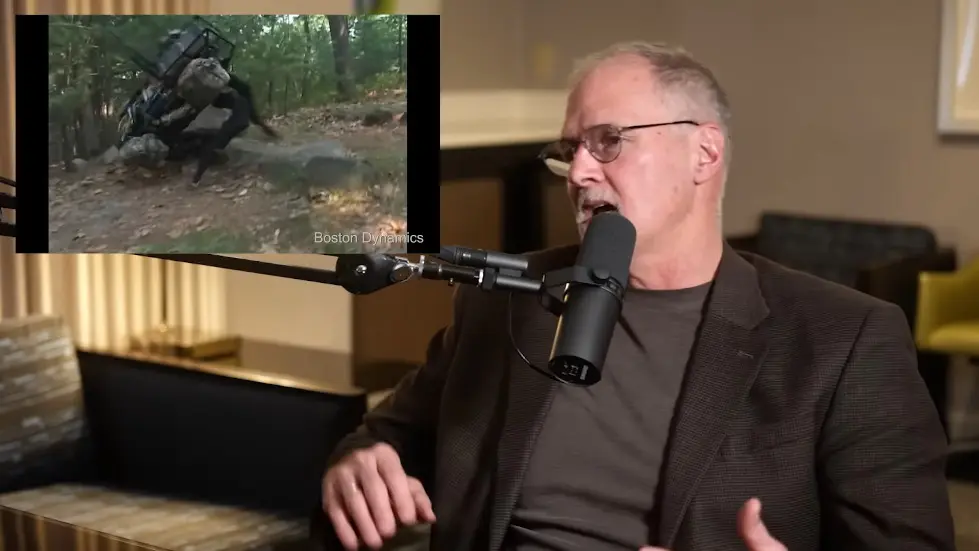
- Walking on loose rubble is a challenging task for robots.
- Building rock piles in parking lots was essential for testing robots.
- Robots need to be able to handle last-minute changes in foot placement.
- Building boxes full of rocks and having robots walk across them was an essential test.
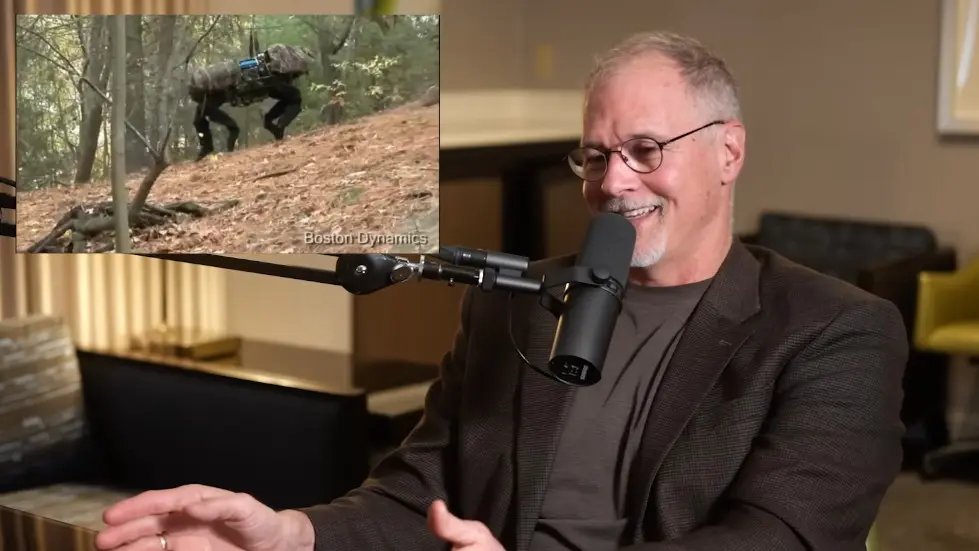
- Big Dog, the robot dog, was a key part of Boston Dynamics' history.

Magic of Robotics
- People tend to attribute feelings to robots because of their organic movement.
- People tend to look at robots and attribute feeling to them.
- People have feelings for their cars, and the same could be said for robots.
- It is important to manage the interaction between humans and robots.
- Putting strong boundaries around the interaction between humans and robots can be a curse.

Introduction
- The video is about Robert Playter, CEO of Boston Dynamics, discussing the development of humanoid and legged robots.
- The company has been creating robots for over 30 years, including the humanoid robot Atlas and the robot dog Spot.
- Playter talks about the challenges of developing robots that can walk naturally and the importance of movement in robotics.
- He also discusses his own interest in gymnastics and how it influenced his appreciation for the elegance and beauty of movement.

Challenges of Developing Robots that Can Walk Naturally
- Playter discusses the challenges of developing robots that can walk naturally, including the need for advanced sensors and algorithms.
- He also talks about the importance of movement in robotics, and how it is essential for creating robots that can interact with humans in a more natural way.
Importance of Movement in Robotics
- Playter emphasizes the importance of movement in robotics, and how it is essential for creating robots that can interact with humans in a more natural way.
- He also talks about the challenges of creating robots that can move naturally, including the need for advanced sensors and algorithms.

Boston Dynamics' Robots
- The video discusses Boston Dynamics' robots, including the humanoid robot Atlas and the robot dog Spot.
- Playter talks about the challenges of developing these robots, including the need for advanced sensors and algorithms.
Conclusion
- The video concludes with a discussion of the challenges and opportunities of developing humanoid and legged robots.
- Playter emphasizes the importance of movement in robotics and the need for advanced sensors and algorithms to create robots that can interact with humans in a more natural way.

Robotics with Sony
- Boston Dynamics was involved with Sony in developing software for their IBO robot.
- The company won a DARPA contract to build a robot dog, which was the genesis of the Big Dog project.
- Big Dog was a quadruped robot that had everything on board, including a power plant, computers, and hydraulic actuators.
- The first version of Big Dog was not very successful and had difficulty stabilizing itself while trying to operate.
- The power plan for Big Dog was a go-kart engine, which was not the best for the robot's hardware at the time.
Big Dog
- Big Dog was a quadruped robot that was rebuilt several times, with the first version being the earliest and least successful.
- The robot had go-kart engines, which were loud and aggressive and not the best for the robot's hardware.
- Managing weight in a legged robot is important, as it has to carry everything it needs.
- The early versions of Big Dog stood about belly high and weighed a couple of hundred pounds.
- Over the course of five years, the robot was able to manage a remarkable level of rough terrain.

Legged Locomotion
- Big Dog cut open the idea of legged locomotion for Boston Dynamics.
- The robot was self-contained and walked around in the world, balancing itself.
- The purpose of Big Dog was to prove to themselves that legged locomotion could really work.
- Big Dog was the beginning of a series of robots that Boston Dynamics built.
- After showing DARPA that a robot could work, robotics became very popular and many different programs were developed.

Other Robots
- Boston Dynamics built other robots, including LS3, which was designed to carry heavy loads.
- Cheetah was designed to explore the limits of how fast a robot could run.
- Boston Dynamics built a portfolio of machines and software that allowed them to build not just one robot but a whole family.
- The company was able to develop principles of legged locomotion, allowing them to build small and big robots.
- Length, payload, terrain, walking speed, and other parameters were now parameters that could be played with.
Birth of Spot
- Spot, the robot dog, was born in 2000.
- Boston Dynamics had been building robots for over 30 years.
- The company started building humanoids after seeing that the government was going to back off from robotics investment.
- Google bought Boston Dynamics and suggested building a smaller, electrically actuated robot.
- Spot was the result of this process and was designed to be a consumer-level product.

Cost and Quality
- Building a consumer-level product was important for Boston Dynamics.
- Cost was a major factor in building a consumer-level product.
- Spot cost around $100,000 or more, which was not affordable for consumers.
- Boston Dynamics focused on building high-quality machines to learn about the important parts of making robots work.
- The company ultimately decided to build robots for the industrial sector because they could afford more expensive machines.
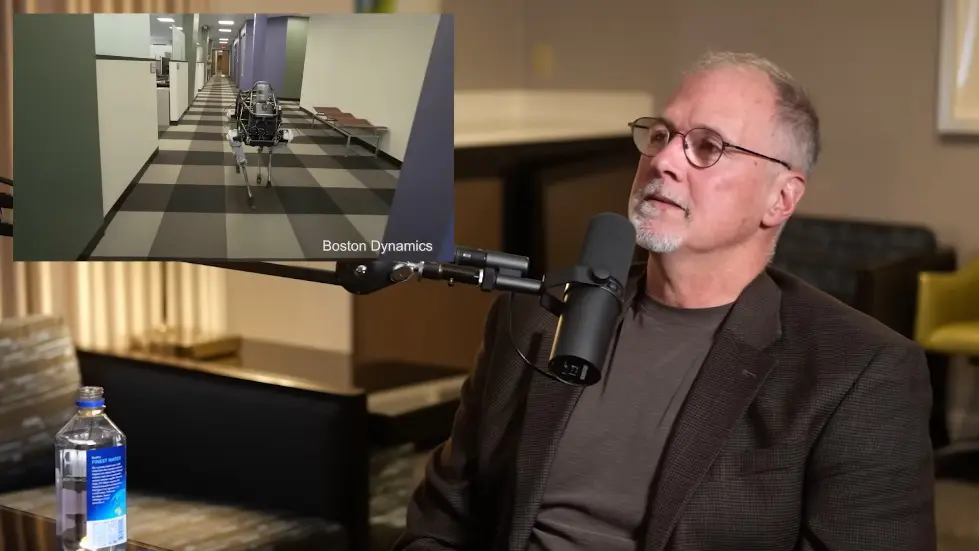
Engineering Challenge
- Bringing down the cost of a robot is a challenging engineering problem.
- The cost of building a robot at scale is also a concern when trying to make money on a robot.
- The transition from an R&D company to a commercial company is a concern.
- Boston Dynamics brought on new people who were inspired by the problems of building robots.
- The big takeaway lesson for Robert Playter is that the company has good people who want to solve problems and the reliability and costs are ultimately required.

You have read 50% of the summary.
To read the other half, please enter your Name and Email. It's FREE.
You can unsubscribe anytime. By entering your email you agree to our Terms & Conditions and Privacy Policy.
Watch the video on YouTube:
Robert Playter: Boston Dynamics CEO on Humanoid and Legged Robotics | Lex Fridman Podcast #374 - YouTube
Related summaries of videos:
- David Pakman: Politics of Trump, Biden, Bernie, AOC, Socialism & Wokeism | Lex Fridman Podcast #375
- Stephen Wolfram: ChatGPT and the Nature of Truth, Reality & Computation | Lex Fridman Podcast #376
- Harvey Silverglate: Freedom of Speech | Lex Fridman Podcast #377
- Anna Frebel: Origin and Evolution of the Universe, Galaxies, and Stars | Lex Fridman Podcast #378
- Randall Kennedy: The N-Word - History of Race, Law, Politics, and Power | Lex Fridman Podcast #379
- Neil Gershenfeld: Self-Replicating Robots and the Future of Fabrication | Lex Fridman Podcast #380
- Chris Lattner: Future of Programming and AI | Lex Fridman Podcast #381
- Bert Kreischer: Comedy, Drinking, Rogan, Segura, Churchill & Kim Jong Un | Lex Fridman Podcast #382
- Mark Zuckerberg: Future of AI at Meta, Facebook, Instagram, and WhatsApp | Lex Fridman Podcast #383
- Matthew McConaughey: Freedom, Truth, Family, Hardship, and Love | Lex Fridman Podcast #384
- Home
- About us
- Contact
- Book Summaries 0-9
- Book Summaries A
- Book Summaries B
- Book Summaries C
- Book Summaries D
- Book Summaries E
- Book Summaries F
- Book Summaries G
- Book Summaries H
- Book Summaries I
- Book Summaries J
- Book Summaries K
- Book Summaries L
- Book Summaries M
- Book Summaries N
- Book Summaries O
- Book Summaries P
- Book Summaries Q
- Book Summaries R
- Book Summaries S
- Book Summaries T
- Book Summaries U
- Book Summaries V
- Book Summaries W
- Book Summaries X
- Book Summaries Y
- Book Summaries Z
- Jay Shetty Podcast - Summaries
- Tom Bilyeu Impact Theory - Summaries
- Lex Fridman - Summaries
- Diary of a CEO - Summaries
- Alex Hormozi - Summaries
